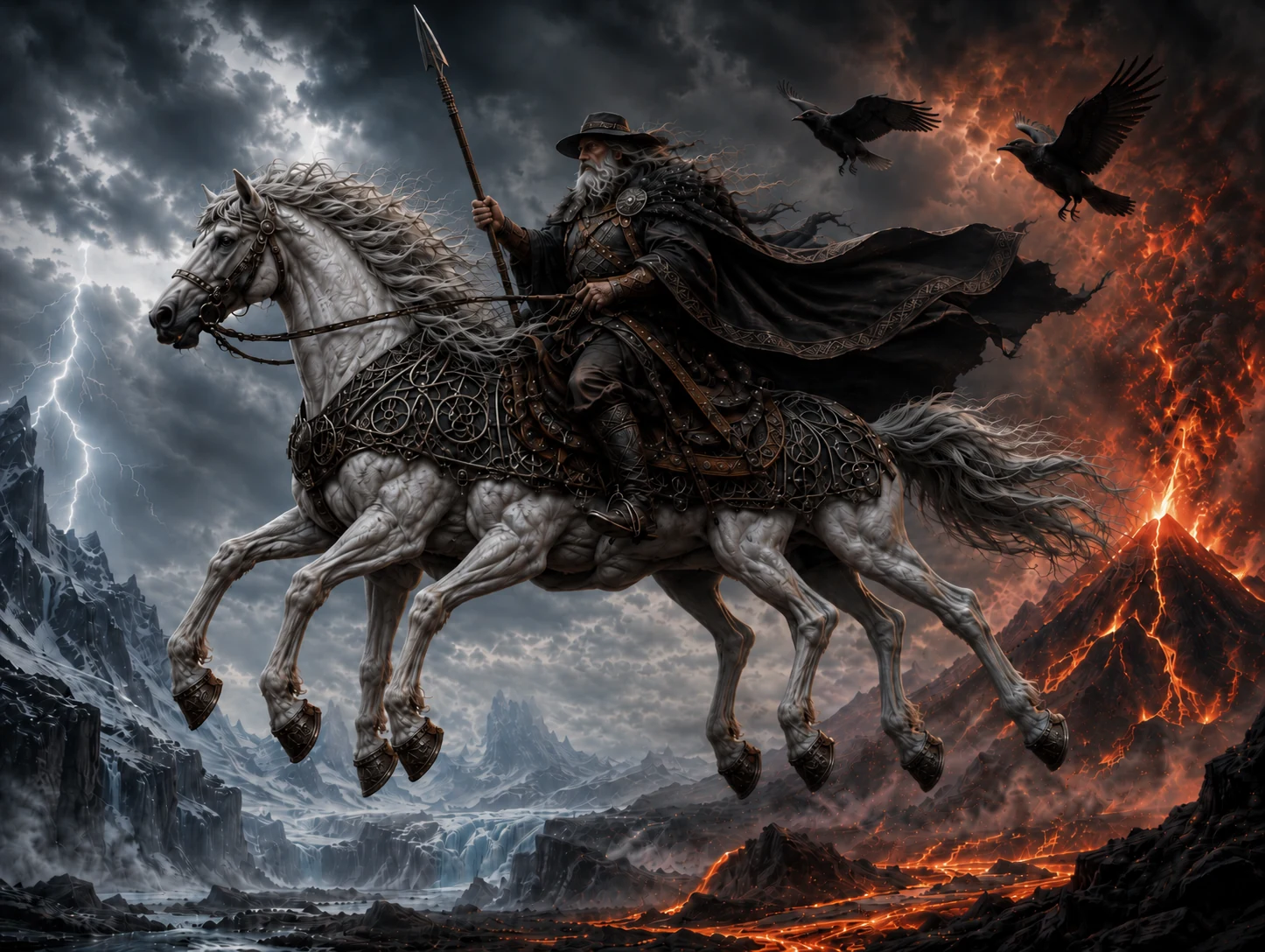
Long before the day comes, Odin already knows the day. He has hung from the world-tree for it. He has traded an eye at Mimir's well for it. The end was never a surprise to the Allfather — only the question of how he would meet it.
I · The HornThe world wakes to thunder
The first sign is sound. Heimdall, watchman at the rainbow bridge, lifts the great horn Gjallarhorn and blows a note that travels through every realm of the nine worlds. It rolls across the frozen seas of Niflheim, splits the cooling rivers of Muspelheim, and shakes the halls of Asgard down to their roots.
The chained things stir. The earth opens. Yggdrasil shudders like a struck mast. And in Valaskjalf, his high-seat, Odin already has his cloak around him and his spear in his hand.
II · The GatheringAllfather commands his Valkyries
From the rafters of Valhalla the einherjar rise — the chosen slain who have feasted and fought there for ages, waiting for one morning only. Odin walks among them in his silver helm, and at his nod the Valkyries sweep down from the high galleries: shield-maidens, choosers of the slain, riders on horses pale as river-ice.
He gives them the order they have always known was coming. Gather them. Bring every spear. Ride to Vigrid. The eight hundred doors of Valhalla open at once, and the einherjar pour out through every one of them: eight hundred warriors abreast through each. Behind them, the Valkyries herd them on like wind herds clouds.
III · The Other GodsEach rides toward a fate
While Odin gathers his army, the other gods are already moving toward the deaths foretold for them. Thor rides his goat-cart out to meet Jörmungandr, the world-serpent risen from the boiling sea. He will kill it, walk nine paces, and fall. Freyr goes against Surtr, the fire-giant with a sword like the sun, and goes without his own sword (long since given away for love), and falls.
Týr rides toward Garmr, the hellhound, and they kill each other. Heimdall goes against Loki, and they kill each other. None of them turn back. None of them are surprised. The prophecy of the Völuspá has been recited in their halls for so long that the words are inside their bones.
IV · The RideEight hooves never touch the ground
Odin mounts Sleipnir, who was foaled of Loki and the giant's stallion Svaðilfari and given to him as a gift in older, kinder centuries. Sleipnir's eight hooves rarely strike the surface of Midgard, moving through air the way other horses move through a meadow.
At Odin's shoulders ride the two ravens Hugin and Munin. Thought and Memory. Each dawn they flew out across the worlds and brought their news back to him at night. Today they fly with him — scouts no longer, witnesses.
The Allfather crosses a landscape already half-undone: glaciers fracturing into the sea, the volcano-lands of Muspelheim opening their veins. Lightning forks through clouds the colour of beaten iron. Through all of it, Sleipnir runs.
V · The WolfVigrid, and the jaws unbound
The plain of Vigrid is a hundred leagues on every side, because the gods needed somewhere their last war could fit. Across it, rising like a mountain that walks, comes Fenrir.
The wolf, son of Loki, was once bound by the gods with a fetter so light and so cunning that the dwarves wove it from impossible things: the sound of a cat's footfall, the breath of a fish, a mountain's roots. He gave them Týr's right hand for the privilege of being bound. On the day the binding breaks, his lower jaw scrapes the earth and his upper jaw the sky, and the world fits inside his open mouth.
Odin sees him coming and does not slow. He has known this meeting since before he gave up his eye to know it. He levels the spear Gungnir, which never misses.
VI · The FallWhat the prophecy promises
The wolf takes him. Hugin and Munin scatter into the smoke, their watching done. Sleipnir runs on without a rider until even his eight hooves can find no air to carry him.
Then Víðarr, Odin's silent son, walks across the field in his great shoe — sewn for centuries from the leather-trimmings every cobbler in the world has thrown away — and steps into the wolf's lower jaw, and tears the upper jaw open with his hands, and avenges his father. It is the last act of the old order.
VII · The AfterAnd then, again, the world
The fire of Surtr eats what is left and the sea swallows the ash. For a while there is nothing. No light, no land, no telling.
Then, slowly, a green earth rises out of the water. Líf and Lífþrasir, two humans who hid in the wood Hoddmímis holt and fed on morning dew, walk out of their hiding place and find the world washed and waiting. The sun's daughter, unburned, takes her mother's place in the sky.
On the new fields the surviving gods gather: Víðarr and Váli, Thor's sons Móði and Magni carrying their father's hammer between them, and Baldr returned from the dead. They sit in the grass and find, lying among it, the golden chess pieces the old gods played with before the world ended. And they begin a new game.
Odin rode out knowing he would not come back, and rode out anyway. Not because the prophecy promised him victory, but because the prophecy promised that after his loss there would be a morning, and a green field, and a new order.
VIII · GlossaryNames that ride with him
Sleipnir
Eight-legged grey stallion, swiftest of all horses. Foaled by Loki. His hooves never strike the ground.
Gungnir
Odin's spear, dwarf-forged. Once thrown, it cannot miss its target — runes carved into its tip bind it to its mark.
Hugin & Munin
Odin's ravens. They fly across the nine worlds each dawn and return at dusk to whisper the day's news in his ears.
Valkyries
Odin's shield-maidens. They ride above battlefields and select the bravest dead to feast in Valhalla until Ragnarok.
Fenrir
Monstrous wolf, son of Loki. Bound by the dwarves with the impossible fetter Gleipnir. On the last day he breaks free.
Vigrid
A field one hundred leagues on each side, named in prophecy as the place where gods and giants will meet on the last day.