Lesson 1.1: What is D&D? Lesson
Learning Targets
I can analyze how published authors use setting details to create mood and meaning.
I can use descriptive vocabulary (setting, world-building, collaborative storytelling) to explain how D&D connects to creative writing.
 Triggering Event
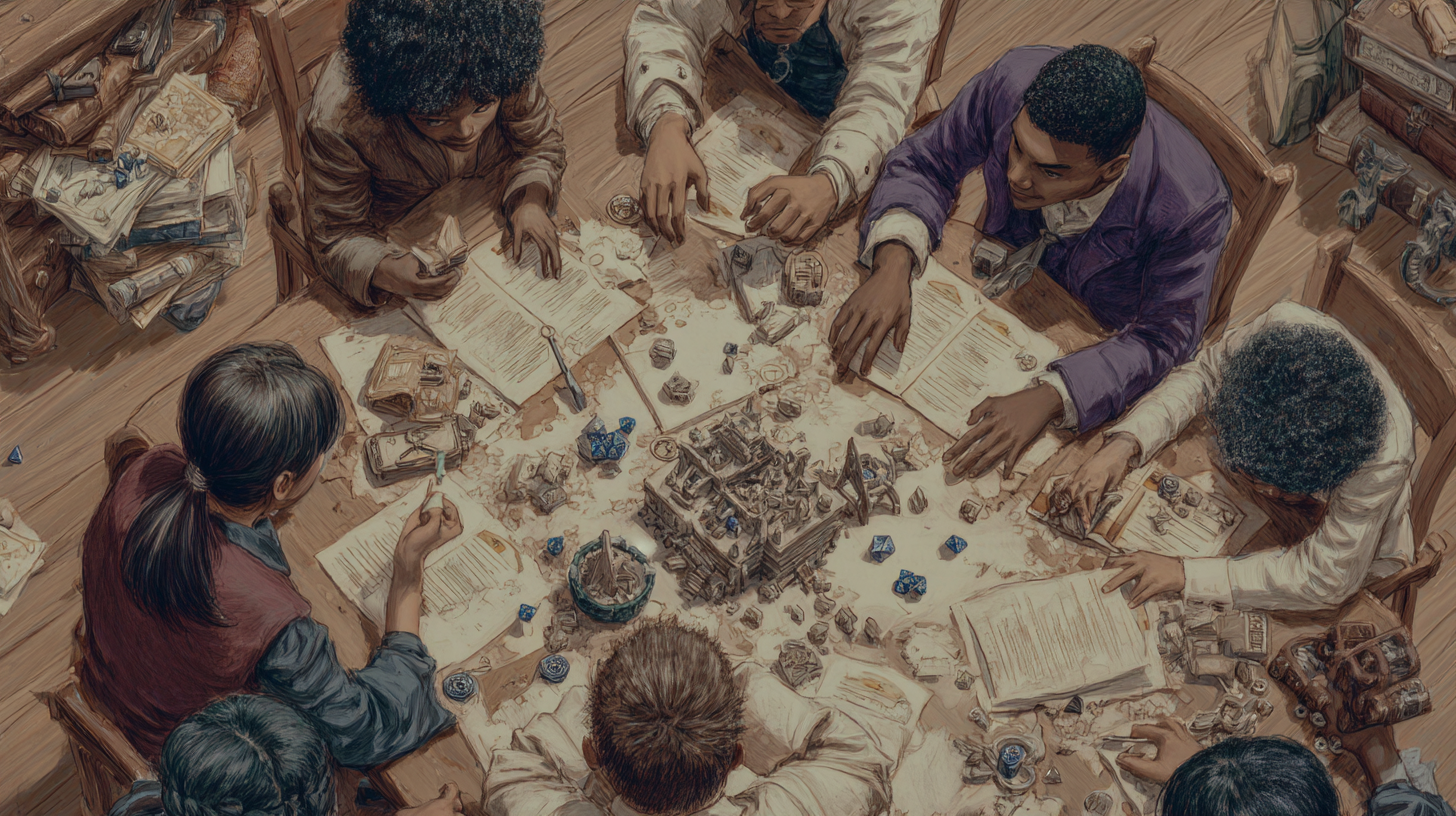
Imagine you're standing at the entrance to a cave. You can hear water dripping somewhere deep inside. The air smells like damp stone and something... metallic. Your torch flickers. What do you do? This is how every D&D adventure begins — not with rules or dice, but with a moment that pulls you into a world someone built with words. In this unit, you're going to become that world-builder.
What is Dungeons & Dragons?
You've probably heard of Dungeons & Dragons as a game with miniatures and character sheets, but here's what makes it powerful for writers: it's collaborative storytelling. One person, called a Dungeon Master or DM, describes a world—a trading post, a forest, a castle under siege—and you, as a player, decide what your character does in response. The DM improvises, you improvise, and together you're building a story in real time. It's like improv theater, except instead of a stage, you have an imagined world.
D&D has been around since 1974, and it's influenced far more than just gaming. Published fantasy authors like N.K. Jemisin, Patrick Rothfuss, and R.A. Salvatore have all played tabletop RPGs and credited them with shaping their creative thinking. Video games, films, and graphic novels all owe something to the storytelling traditions D&D established. And in the past decade, D&D has experienced a major cultural resurgence—people from all backgrounds and communities around the world are discovering it as a way to tell stories together.
Unlike books or movies where stories are consumed, D&D creates stories that are lived. When you play D&D, you don't watch a character make a decision — you make it yourself, in real time, with real consequences. This is why D&D develops writers: it forces you to inhabit a story rather than observe one.
The Dungeon Master as World-Builder
The DM's job is to create and describe the world. They invent the geography—mountains, rivers, towns—and populate it with cultures, histories, conflicts, and characters. Essentially, the DM does what a fiction author does: they build a setting that feels real enough that other people can make meaningful decisions within it. When you're writing a novel, you do the same thing. You describe a setting so vividly that your readers can see it, smell it, and believe in it. The skills are identical.
The difference is that the DM gets instant feedback. If a player says, "I don't believe that character would do that," the DM has to respond, adjust, and keep the story moving. This forces writers to think on their feet and make quick decisions about motivation, emotion, and detail—skills that transfer directly to revising your own written work.
Why D&D Develops Writers
D&D develops three specific creative capacities that transfer directly to fiction writing:
Emergent Narrative. In D&D, stories emerge from the interaction between what the DM prepares and what players improvise. No one controls the whole story. The best Dungeon Masters learn to create frameworks rather than scripts — they build a world with enough detail that stories can grow naturally from the characters' choices. This is exactly how the best fiction works: the author creates conditions for story, and the characters' decisions drive the narrative forward.
Character Agency. In D&D, characters are controlled by real people who make genuine choices based on their character's personality, goals, and values. This forces everyone at the table to think deeply about motivation. Why would this character open that door? Why would they trust this stranger? When you write fiction, you need the same discipline — characters who act for clear, consistent reasons, not because the plot requires it.
Collaborative World-Building. D&D worlds grow through collective imagination. A town the DM described in one sentence might become central to the campaign because a player decided their character grew up there. Details suggested by one person get expanded by others. This collaborative layering creates worlds richer than any single imagination could produce — and it mirrors how the best writers build on research, conversation, and lived experience to create settings that feel real.
Why D&D Makes You a Better Writer
Playing D&D (or other tabletop RPGs) develops specific creative writing skills. When you improvise dialogue for a character, you're practicing fluency—the ability to get words down without overthinking every sentence. When you help the DM describe what your character sees and feels, you're practicing sensory detail and vivid language. When you make decisions about who your character is and why they act, you're thinking about characterization the way published authors do. And when you weave your story with other players' choices, you're learning narrative structure—how scenes connect, how tension builds, how stakes matter. All of these are central to creative writing craft.
It's worth noting that D&D's influence on world-building extends across cultural traditions. Published authors from diverse backgrounds have shaped modern fantasy and tabletop RPGs. Games like Ryuutama (Japanese), influenced by the road-narrative tradition, bring different storytelling approaches. Latin American adaptations and Afrofuturist settings in games like Coyote & Crow are expanding what tabletop RPGs can be. When you learn world-building, you're not learning one "right" way—you're learning that there are many approaches, many cultural traditions, and many kinds of stories worth telling.
D&D Beyond the Mainstream
While Dungeons & Dragons is the most well-known tabletop RPG, it's far from the only one. Games like Ryuutama bring Japanese sensibilities to fantasy storytelling. Nahual centers Mesoamerican mythology. Coyote & Crow is built on Indigenous Futurism and centering Native American voices. This diversity matters deeply to you as a writer because world-building is richer, more imaginative, and more respectful when it draws from many traditions, not just European medieval fantasy. As you work through this unit, you'll notice opportunities to incorporate different cultural perspectives into your own world-building—not as decoration, but as foundation.

Key Vocabulary
Sentence Frames
Use these frames to help you articulate what you're learning:
 Finding Your Voice
Think about the kinds of stories that excite you most. Are you drawn to epic quests, mysterious investigations, political intrigue, coming-of-age journeys, or something else entirely? Your preferences as a reader and player reveal something about you as a storyteller. As you work through this unit, pay attention to what choices you're drawn to—they'll help you find your creative voice and inform the kinds of worlds you build.

What's Next
Now complete the Check Your Understanding: D&D and Storytelling Foundations to make sure you're ready for the next lesson.